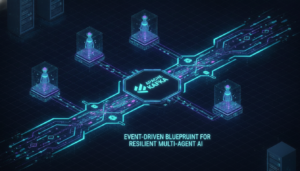
The Event-Driven Blueprint for Resilient Multi-Agent AI

How to eliminate cascading failures and scale autonomous agents independently using Apache Kafka.
What happens to your multi-agent architecture when your upstream LLM provider experiences a 90-second latency spike or a brief regional outage?
If your agents are wired together through synchronous REST APIs or in-memory method chains, the answer is painful: connection pools saturate, web clients hit HTTP 504 gateway timeouts, in-flight data vanishes, and your end users are forced to hit “refresh,” triggering duplicate, expensive model inference calls.
In Part 1 of our series, we established that multi-agent systems are fundamentally distributed systems. Today, in Part 2, we explore how to eliminate the fragility of synchronous agent chaining by adopting a battle-tested enterprise paradigm: Event-Driven Architecture (EDA) powered by Apache Kafka.
During our recent livestream on the Out of the Box Developer Podcast, Denis gave us a masterclass on orchestrating autonomous agents as asynchronous event processors. Let’s examine the architectural mechanics behind this design.
Moving from Request-Response to Autonomous Event Processors
In traditional microservice design, software architects learned long ago that point-to-point synchronous RPC calls create tight temporal coupling. If Service A cannot talk to Service B in real time, Service A fails.
Denis highlighted how Event-Driven Architecture fundamentally solves this problem in enterprise backends:
“I have been using event-driven architecture for many years. It is an architecture pattern composed of independent event processors and an event bus where events are published. In an e-commerce company, you might have different event processors: one for inventory, another for payments, and a third for shipping. Each service is independent and loosely coupled. The inventory service receives an event, processes it, and publishes a new event to the bus for other processors to consume. If there is an issue or failure in one processor, the others keep working. They process events asynchronously, and each one can scale independently.”
When you apply this pattern to generative AI pipelines, every AI agent stops being an endpoint that sits waiting for incoming HTTP requests. Instead, each AI agent becomes an autonomous event processor subscribed to an event stream.
Denis proposed this unified model:
“My proposal here is to combine event-driven architecture with multi-agent systems in order to have a resilient multi-agent system. Each AI agent works as an independent event processor. They do not have direct dependencies between each other because they communicate exclusively through events. Because they are loosely coupled, a failure or latency spike in one agent’s tools will not affect the other agents. The pipeline handles parallel processing, delivers high throughput, and remains completely flexible.”
Inside the Pipeline: How Kafka Orchestrates Agent Flow
During his live demonstration, Denis showcased an automated content publishing engine designed for a media streaming platform. When a creator uploads draft content, the system must enrich metadata, verify age and regional compliance, and draft promotional social copy.
I wanted to drill into the exact communication topology, so I asked:
“Is Kafka used only for the first user interaction, or is it also used in each step of enrichment and analysis between the agents?”
Denis walked through the exact flow:
“We are using Kafka for all interactions to exchange events between agents. There are different topics between each agent. The backend for the frontend first publishes the content to initiate the pipeline. That message goes to the first agent via a dedicated Kafka topic. Each agent processes the event, enriches the payload, and produces to the next topic. When the final agent finishes, the backend consumes the final message and updates the web UI.”
Here is the operational pipeline:
- Content Enrichment Processor: Subscribes to
content.submitted. It calls GPT-4o to extract narrative themes, emotional tone, and audience keywords. It publishes anenriched.contentevent containing the original text plus structured metadata. - Sensitivity & Compliance Processor: Subscribes to
enriched.content. It scans the text and extracted themes against regional content guidelines and age rating rules. It appends compliance flags and publishescompliance.verified. - Marketing Specialist Processor: Subscribes to
compliance.verified. It synthesizes all previous metadata to craft localized headlines, taglines, and social media copy. It emitscontent.published, which updates the frontend catalog.
Why This Architecture Wins in Production
By placing an event bus like Kafka between your agents, you immediately unlock four critical operational superpowers:
1. Complete Temporal Decoupling
If the Marketing Agent crashes due to a poison-pill payload or a temporary deployment, the Content Enrichment and Compliance agents don’t stop. They continue processing incoming submissions. The messages destined for the Marketing Agent simply accumulate safely in the Kafka topic log until the consumer service recovers.
2. Independent Horizontal Elasticity
Not all agent workloads are computationally equal. An enrichment agent summarizing a 10,000-word transcript might take 8 seconds of model processing, while a tagline generator takes 700 milliseconds. In a synchronous script, your throughput is throttled by the slowest agent. With Kafka consumer groups, you can scale the Enrichment Agent to 10 container replicas while running only 2 replicas of the Tagline Agent.
3. Full Auditability and Event Replay
Kafka is a distributed commit log, not an ephemeral message queue. Because events are persisted to disk, you gain complete operational replayability. If you refine your compliance system prompt next month, you can reset consumer offsets and re-run thousands of historical records through the updated Sensitivity Agent without re-running upstream enrichment or re-fetching raw data!
4. Zero-Friction Extensibility
What happens when marketing requests an automated Spanish and Portuguese translation agent? In a monolithic script, you would have to alter core business logic. In an event-driven system, you simply write a new consumer that listens to content.published and operates completely out-of-band.
Key Architectural Takeaways
- Replace synchronous RPC with event streams: Decouple agent workflows using durable message brokers like Apache Kafka, RabbitMQ, or AWS SQS.
- Enrich payloads progressively: Pass state downstream by appending validated metadata to the event schema, allowing downstream agents to inspect the complete audit trail.
- Scale consumers by workload profile: Exploit consumer groups to scale compute-intensive reasoning agents independently from lightweight formatting agents.
Listen to the full deep dive here.
Are you utilizing message brokers in your agent architectures, or are you still orchestrating in-memory? Share your current architecture in the comments below!
Cheers,
Pedro Cavalero
P.S. In Part 3—the final installment of our series next Sunday—we dive into production survival. I’ll share Denis’s battle-tested patterns for circuit breakers with multi-model fallbacks (switching between OpenAI and Gemini), Dead-Letter Queues, and how to track distributed OpenTelemetry traces and token costs in Grafana.