From Vibe Coding to Spec-Driven Development: The Shift in AI-Assisted Engineering
Hey fellow devs!
Have you ever found yourself in the middle of a coding session where you just write a prompt like “create a simple authentication dashboard,” run the output, see an error, copy the error back to the AI, and repeat this loop ten times? If so, you’ve participated in the trend known as “vibe coding.” It was the defining trend of last year’s generative AI explosion.
But things are shifting. As AI gets integrated into serious production codebases inside engineering organizations, vibe coding is showing its limits. Today, we are seeing the rise of Spec-Driven Development (SDD). Let’s dive into why this change is happening and how it will redefine the way you work with code.
What is Vibe Coding?
Vibe coding is the practice of developing software by relying on instant feedback loops and intuitive prompts without a formal plan. You write a brief description of what you want, watch the AI output hundreds of lines of code, and then manually patch the errors as they arise.
It is highly interactive and feels incredibly fast. For hackathons, personal side projects, and flashy internet videos, vibe coding is perfect. But when you try to apply vibe coding to a large, complex repository with legacy dependencies and strict styling requirements, it quickly falls apart. You end up with a codebase full of duplicate logic, architectural violations, and code that is difficult for other humans to read or maintain.
Enter Spec-Driven Development (SDD)
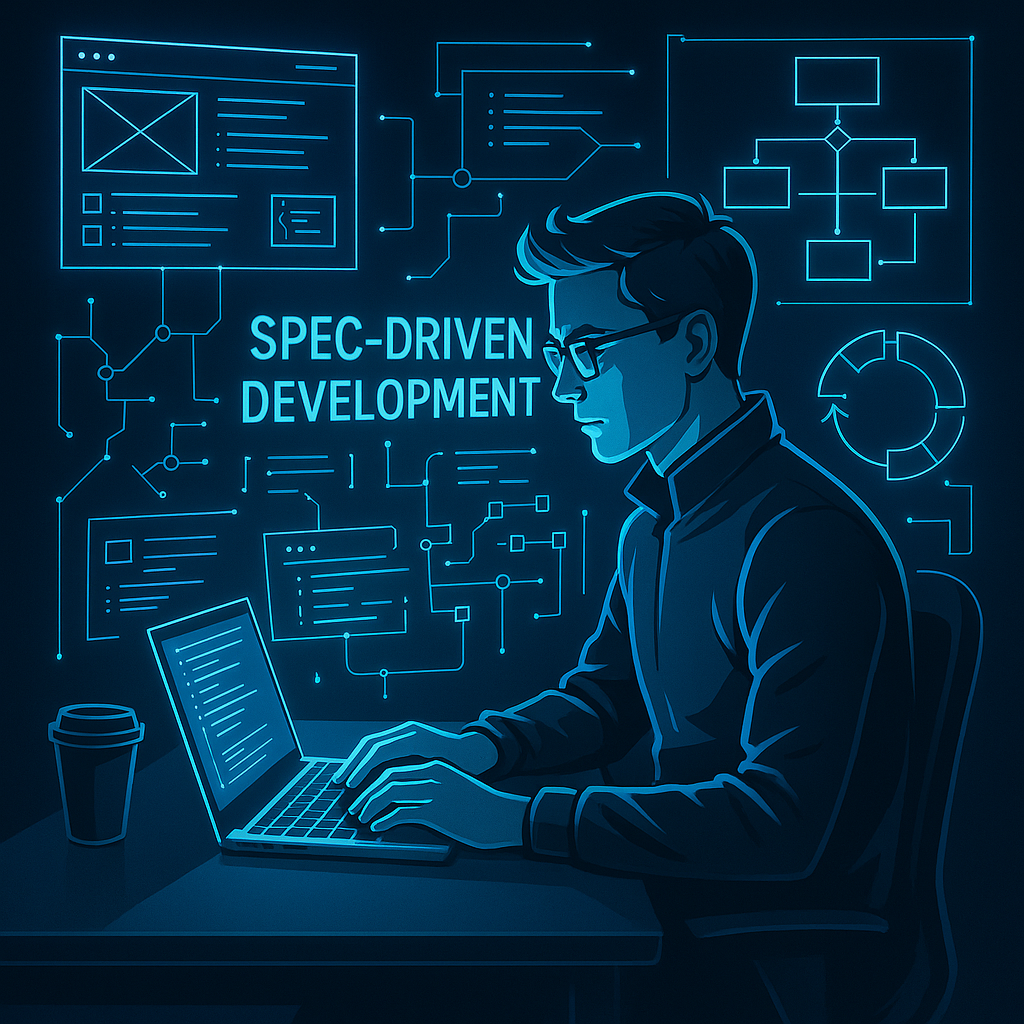
Spec-Driven Development is the logical answer to vibe coding. Instead of jumping straight into code generation, developers write a clear, structured specification in natural language first. This specification outlines the objectives, constraints, inputs, outputs, and design requirements of a feature before the AI coding agent touches a single file.
During our recent podcast session, my colleague Pedro Cavalero highlighted this shift:
Pedro: “If last year was the year of vibe coding, this year will be the year of spec-driven development because this will be when AI will get to us all inside the companies—not only people who are trying to do some demos on the internet.”
By shifting the focus from code typing to spec design, teams can establish structure and discipline in their workflows, ensuring that AI-generated code integrates seamlessly into the overall system architecture.
Why Specifying First Stops the “Go-Horse” Mess
We all know the “Go-Horse” methodology. It’s the practice of writing code as fast as possible without thinking about architecture or long-term maintenance. In the age of AI, Go-Horse became even faster because AI can generate lines of code at an unprecedented rate. However, without a specification, you are just automating the creation of legacy technical debt.
Spec-Driven Development is the biggest enemy of Go-Horse projects. It forces you to think through the design before writing code.
Is this upfront planning slower? Initially, yes. It feels slower because you aren’t seeing immediate code output. But it saves you hours of debugging down the line. As Yugo explained during our conversation:
Yugo: “Every time I try to do something more extreme programming, like if I just have a few minutes to prepare, I wouldn’t go to specification first and then write code. I just go coding, generate, and see what happens—and it works for a proof of concept. But spec-driven development is the way when we have to be more organized and careful about the deliveries we do. It feels slower to do things at first, but it is the organized way.”
By taking the time to write a specification, you ensure that the AI has a solid, bounded context. It won’t have to guess your intentions, which reduces hallucinations and infinite debugging loops by a massive margin.
How to Get Started with Spec-Driven Development
If you want to start using SDD in your daily routine, you don’t need fancy, expensive enterprise tools. You can start with basic markdown files. Here is the step-by-step workflow:
- Write a Compact Spec: Open a new markdown file (e.g.,
feature-spec.md) and describe the objective, requirements, and constraints. Keep it short enough for a human to read in two minutes. - Review the Design: Read through the spec. If it makes sense to you, it will make sense to the AI.
- Feed it to the Agent: Point your AI coding agent (like Cursor, Copilot, or Gemini) to the specification and say: “Read this spec and implement the feature.”
- Audit and Validate: Verify the output, run your unit tests, and make manual adjustments where necessary.
By adopting this workflow, you transition from a coder who writes syntax to an engineer who designs intentions.
What are your thoughts on this? Have you tried Spec-Driven Development, or are you still vibe coding? Share in the comments below!
Watch the full video here for our detailed team discussion.
Happy coding!
Cheers,
Pedro Cavalero