Beyond the Hype: Why 70% of AI Success Isn’t About Models
Why most AI agent projects fail, and the 70/20/10 rule every engineering leader needs to know.
How much time did your engineering team spend this past month debating which LLM benchmark or new model release was going to “disrupt” your entire software stack?
If you feel overwhelmed by the nonstop flood of AI hype, you are not alone. Every single week, social media influencers declare that existing developer workflows are dead, that software engineers are obsolete, or that a new open-source weights drop changes everything overnight.
In our latest podcast episode, our dear friend, veteran educator, and Java Champion Professor Isidro joined us to share a much-needed perspective on this transition. Drawing from nearly three decades in the computer science trenches, he reminded us that we have seen this movie before—and shared an indispensable operational framework: The 70/20/10 Rule for AI Projects.
Let’s unpack why chasing model benchmarks is a trap, and where real engineering value actually lives.
Historical Perspective: Surviving Four Tech Waves
When you have weathered multiple industry cycles, you gain the ability to look at major disruptions with calmness and strategic discipline rather than anxiety.
During our conversation, Professor Isidro walked us through the four great technological movements of modern computing:
- The Personal Computer Wave (Early 1990s): When PCs entered the workplace, widespread panic suggested office workers and administrators would be replaced. Instead, computing power expanded business capabilities and sparked the modern knowledge economy.
- The Y2K Millennium Bug (Late 1990s): Mainstream media predicted global financial collapse and critical infrastructure failures. Software engineers methodically audited codebases, corrected the two-digit date logic, and kept the world running seamlessly.
- The Cloud Computing Era (2010s): Critics argued that centralized cloud software would eliminate the need for in-house engineering teams. Instead, it gave birth to entire disciplines—DevOps, SRE, distributed systems architecture, microservices, and modern streaming platforms.
- The Artificial Intelligence Revolution (Today): AI is the fourth major wave. Just like the shifts before it, AI does not eliminate software engineering—it elevates our abstraction level.
As Professor Isidro noted during the episode:
“What is the big advantage of having lived through these cycles? You can experience all these movements with serenity and calm, without getting consumed by the hype. If you try to predict every turn of the future and get anxious about it, you will stall your engineering career.”
The 70/20/10 Rule: Why AI Projects Really Succeed (or Fail)
Why do so many ambitious AI agent initiatives and internal prototypes quietly fail once they reach production?
It almost never comes down to model intelligence. Instead, teams fail because they invert their priorities, dedicating 90% of their energy to model selection while neglecting business workflows and system boundaries.
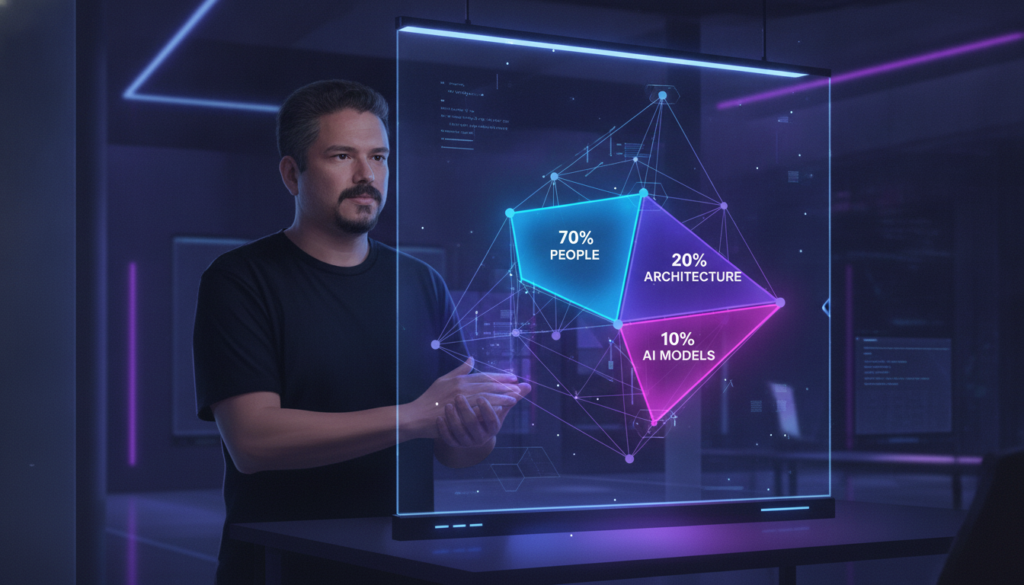
Professor Isidro highlighted a crucial ratio observed across real-world software agent implementations: The 70/20/10 Rule.
+-------------------------------------------------------------+
|                     70% People & Process                    |
|   (Domain understanding, business rules, edge-case flows)   |
+------------------------------------+------------------------+
|        20% Tech Architecture       |      10% AI Model      |
|    (APIs, databases, guardrails)   |    (LLM provider)      |
+------------------------------------+------------------------+
1. 70% — People and Internal Business Processes
The overwhelming majority of your project’s success hinges on whether you clearly understand the domain problem. What is the exact sequence of operational steps? What are the business exceptions? Who are the stakeholders? If your team cannot articulate the workflow clearly on a whiteboard, no frontier model will magically figure it out for you.
2. 20% — Software Architecture and Engineering Foundations
This represents your technical infrastructure: clean API contracts, robust database schemas, deterministic orchestration, validation pipelines, and automated test coverage. A great architecture provides the guardrails that prevent AI agents from going off the rails.
3. 10% — The Underlying AI Model
The specific model—whether Claude, GPT-4, or Gemini—accounts for only roughly 10% of total project success. When your domain processes and architecture are solid, swapping LLM providers is an implementation detail. But if your 70% is broken, no model upgrade will fix the underlying failure.
Shifting from Spectator to Strategic Builder
When DeepSeek or new open-source models drop, tech influencers scream disruption. Yet in enterprise environments, the teams making real progress are the ones focusing on deterministic execution.
Pedro: “Being empowered by AI is a skill that every software professional needs to build. But you must approach it with curiosity rather than anxiety.”
Instead of asking “Which model is 2% faster on benchmark X?”, ask: – What manual business bottleneck is slowing down our team this quarter? – How can we design deterministic guardrails around our LLM calls? – Are our business processes documented well enough for an agent to execute them reliably?
Key Takeaways for Technical Leaders
- Lead with Process, Not Compute: Never start an AI project by picking a model. Map out the full end-to-end human workflow, inputs, and constraints first.
- Treat Models as Swappable Components: Design your system boundaries so that the LLM is just an interchangeable 10% component behind a clean API interface.
- Filter Out Influencer Noise: Evaluate new releases through the lens of your production architecture, not social media benchmarks.
Listen to the full deep dive here to hear the complete discussion with Professor Isidro!
How is your engineering team structuring AI initiatives? Are you seeing the 70/20/10 dynamic play out in your organization? Leave a comment below!
Cheers,
Pedro Cavalero
P.S. In Part 2 next week, we dive into The High-Impact Contributor (HIC) model—dissecting how senior engineers can orchestrate modular, on-demand AI “Skills” to operate like a 10-person virtual team.