How to Build Company Playbooks with Version Controlled AI Skills
Hey fellow devs!
How does your team currently use AI? Chances are, almost everyone on your team is using a chat interface like Claude, ChatGPT, or Gemini on their own.
One developer might craft an elaborate, highly detailed prompt and get fantastic results. Meanwhile, another engineer down the hall types a quick, vague query and ends up frustrated with hallucinations and low-quality output.
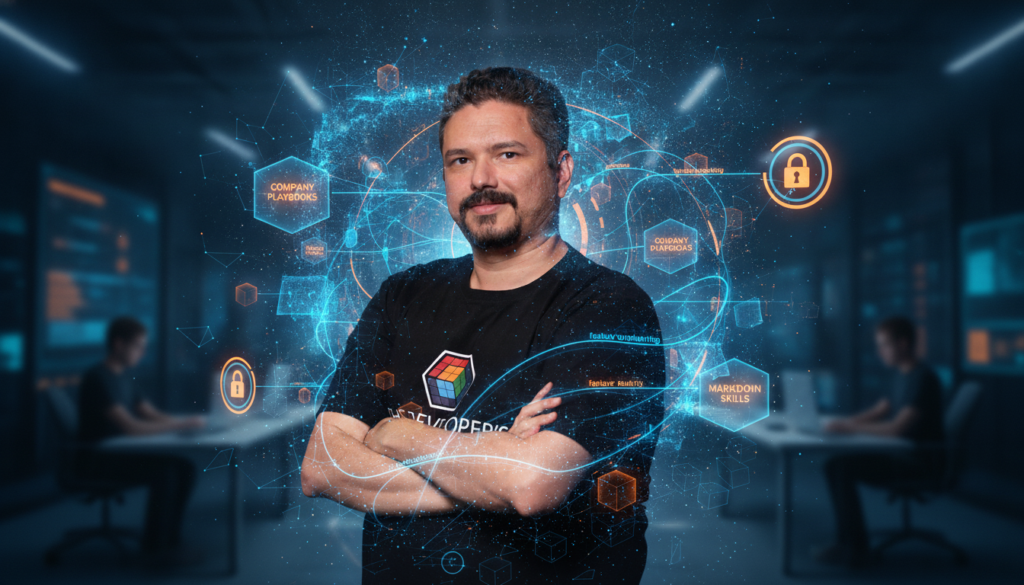
Why does this happen? When AI usage is isolated to individual chat windows, you have no consistency, no quality control, and zero institutional memory. In our podcast with Professor Isidro, we explored how engineering teams can solve this problem by transforming AI prompts into version-controlled Markdown Skills that act as living company playbooks. Let’s see how this works!
The Trap of Ad-Hoc AI Prompts
Think about how standard procedures work in any growing software organization. If you want everyone to follow the same Git branching strategy or API design guidelines, do you leave it to each engineer’s personal memory? Of course not—you document it in a repository or handbook.
Yet, when it comes to AI, most organizations do the exact opposite:
“` Ad-Hoc Individual Chats: – Developer A (Great Prompter) -> Excellent Code & Tests – Developer B (Vague Prompter) -> Broken Code, Security Flaws – No auditability, no versioning, no team alignment
Company Skills Repository (Git-Controlled): – Shared Markdown Playbooks (Stored on GitHub) – Version-controlled, peer-reviewed, and standardized – Every team member achieves consistent, verified output “`
Professor Isidro: “If Claude or any AI is simply used as an ad-hoc tool, you can give the exact same model to two employees: one will extract the best results, and the other will extract the worst. But if you adopt AI Skills as your operational foundation, the context is no longer trapped in a single user’s head—it becomes your company’s context.”
Why Version-Controlled Skills Change Everything
What makes an AI Skill so powerful for teams? It comes down to three foundational software engineering principles: Auditing, Version Control, and Reproducibility.
Because skills are written as simple Markdown and text files, you can treat them exactly like source code:
- Git Governance: You can store all your team’s skills in a shared GitHub organization or repository. Every update, fix, and improvement can go through standard Pull Requests and code reviews.
- Rollback & Evolution: If an AI skill update produces unexpected responses, you can view the git diff and roll back to a previous commit instantly.
- Institutional Knowledge Retention: When standard operating procedures (SOPs) are captured as skills, onboarding new developers becomes effortless. They don’t have to guess the right prompts; they simply load the approved team skill.
Professor Isidro: “Using skills, you can have real governance. You store your skills in a GitHub repository where they can be versioned, audited, and updated. You create an organization on GitHub, and anyone on your team can download and run the latest skills in their day-to-day work.”
What Does a Production Company Skill Look Like?
A well-architected skill file is structured, explicit, and deterministic. It typically contains:
- Role & Objective: Exactly who the assistant is and what goal it must accomplish.
- Input Parameters: The required data, schema, or file references.
- Step-by-Step Workflow: A clear, sequential execution process.
- Constraints & Edge Cases: What the AI is not allowed to do (e.g., formatting rules, security restrictions).
- Example Inputs & Expected Outputs (Few-Shot Examples): Golden examples that illustrate ideal responses.
Here is a simplified example of what a team’s code-review-playbook.md skill might look like:
“`markdown
Team Code Review Skill
Role & Goal
You are a Senior Security & Architecture Reviewer for our engineering team. Review the provided pull request diff against our team’s coding guidelines.
Review Rules
- Verify database queries for indexing and N+1 query patterns.
- Ensure all public endpoints implement authentication middleware.
- Highlight any missing unit test coverage.
- Format all feedback as concise, actionable GitHub comments.
Constraints
- Never approve a PR that exposes raw database errors to the client.
- Do not nitpick stylistic choices that are enforced by our linter. “`
When every engineer runs this standardized skill before submitting or merging a PR, code quality across the entire organization rises dramatically.
Convincing Engineering Leadership to Adopt AI
Have you ever struggled to get budget or approval for AI tools from your CTO or engineering manager? Often, leaders are hesitant because they worry about security, hallucinations, and lack of accountability.
Showing your leadership a structured, version-controlled repository of Markdown skills provides the exact assurance they’re looking for:
Professor Isidro: “The main challenge when trying to convince leadership to adopt an AI platform is explaining why we need it. AI Skills provide a clear, compelling answer because you can manage and audit your company playbooks systematically.”
Leaders don’t want black-box chaos; they want repeatable, measurable workflows. AI Skills give them that governance.
Key Takeaways
- Standardize beyond chat: Move away from individual, unversioned prompts toward shared company skills.
- Treat skills as code: Store your skill files in Git, review updates with Pull Requests, and maintain full version history.
- Empower every team member: Allow junior and senior engineers alike to benefit from the highest quality playbooks across the company.
Watch the full video here to see how Professor Isidro structures and manages AI skills for team operations!
Does your company currently share prompts or documentation for AI tools? How could a version-controlled skills repo improve your workflow? Share your thoughts below!
Cheers,
Pedro Cavalero